Task Inertia
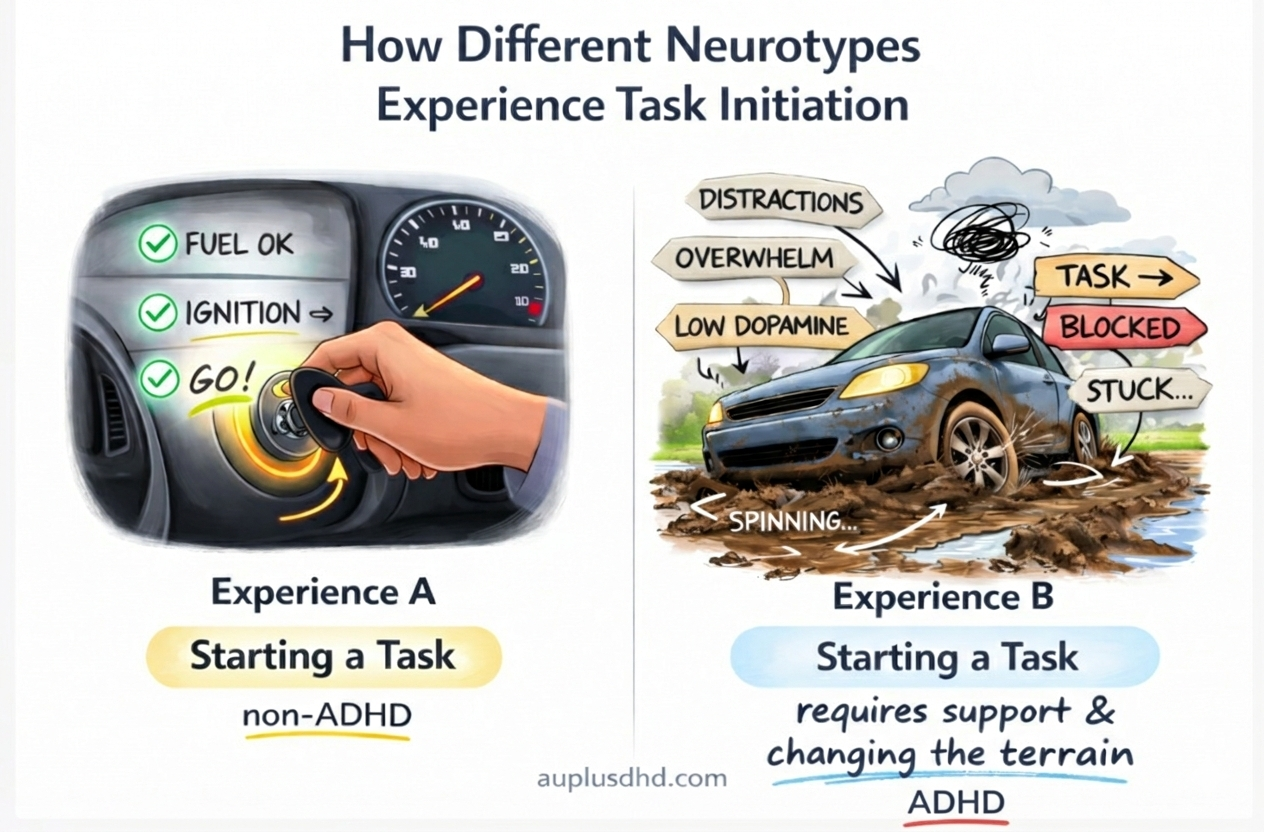
🧠 How Different Neurotypes Experience Starting a Task
When an ADHD individual struggles to start a task, most people were taught to see as a motivation problem. It’s not.
Experience A: The Non-ADHD Brain
Design: An engine that runs on internal fuel.
For many non-ADHD individuals, the brain is designed like a standard car with a full tank and a ready-to-start ignition system. The energy to start a task is generated internally.
- How It Works: The brain recognizes a task, produces the necessary internal fuel (dopamine, motivation), and engages the ignition. It's a self-contained system.
- The intention-activation gap is small.
Experience B: The ADHD Brain
Design: A high-performance engine that requires external support.
For many ADHD brains, the engine is powerful but operates differently. It is designed to be extrinsically linked—it needs the right circumstances and environment to perform at its optimal capacity. The internal fuel system works differently, so it relies on external sources to get moving.
What gets labeled as:
- “low motivation”
- “easily distracted”
- “procrastination”
Is actually:
- Task Inertia Phenomenon
- Thought Stream Interruptions
- Emotional Overwhelm
The ADHD neurotype doesn’t start tasks just because they’re important. It starts tasks when the conditions are right ( the terrain):
- enough interest ( dopamine)
- enough urgency
- enough structure
- enough support
So what looks like being “stuck”… Is actually a system trying to move without the traction it needs.
🧩 The shift:
It’s not:
“Why can’t I start?”
It’s:
“What conditions does my brain need to activate?”
If this image resonates with you, know that the solution for task inertia isn't about trying harder, but about changing the terrain ( the conditions) so your brain can move.